
Description
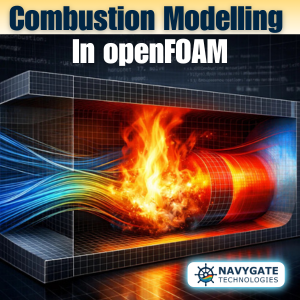
This course provides a practical and detailed introduction to combustion modeling using OpenFOAM, one of the most widely used open-source computational fluid dynamics (CFD) platforms. The focus of this course is to help engineers, researchers, and students understand how reacting flow simulations are performed in OpenFOAM and how different combustion solvers are configured and used in real CFD problems.
The course begins with an explanation of the fundamental equations governing reacting flows, including the continuity equation, momentum equation, species transport equations, and energy equation. You will learn how these equations are solved sequentially inside OpenFOAM solvers and how the pressure–velocity coupling algorithms such as PIMPLE are used to maintain numerical stability in reacting flow simulations.
A major focus of the course is the practical setup of combustion simulations. You will learn how to build complete OpenFOAM cases from scratch by creating the required case structure, generating meshes, defining boundary conditions, and configuring solver settings. The course demonstrates how to generate structured meshes using blockMesh, apply mesh grading for better resolution in critical regions, and prepare simulation domains suitable for reacting flow problems.
The course also explains how chemical reactions are introduced into CFD simulations. You will learn how to enable chemistry solvers, define reaction mechanisms, and include species transport in the simulation. Detailed chemistry models are introduced using reaction mechanisms, and the course explains how OpenFOAM handles chemical kinetics and species evolution during combustion.
Another important topic covered in the course is turbulence–chemistry interaction modeling. You will learn how turbulence affects combustion processes and how models such as the Eddy Dissipation Concept (EDC) are used to represent the interaction between turbulence and chemical reactions. The course also demonstrates how combustion affects flow properties such as temperature, species concentration, and velocity fields.
In addition to case setup and simulations, the course includes solver code walkthroughs so you can understand how combustion solvers are implemented internally. You will explore the structure and algorithm of solvers such as reactingFoam and XiFoam, which are commonly used for modeling reacting flows and premixed combustion. Understanding the solver code helps you gain deeper insight into how combustion models are implemented and how they influence simulation results.
The course also demonstrates how to run simulations efficiently using parallel computing in OpenFOAM. You will learn how to decompose the computational domain and run large reacting flow simulations faster using multiple processors.
By the end of this course, you will be able to set up, run, and analyze combustion simulations in OpenFOAM, understand the governing models used in reacting solvers, and interpret results such as temperature fields, species distributions, and reaction zones. This knowledge is highly valuable for engineers and researchers working in fields such as energy systems, gas turbines, fire modeling, propulsion, and chemical process simulations.
The course includes step-by-step video lectures, downloadable PDF notes, and complete OpenFOAM case files, allowing you to reproduce every simulation and practice the concepts on your own system. This combination of theory and hands-on implementation ensures that you gain both conceptual understanding and practical experience in combustion CFD using OpenFOAM.

Reviews
There are no reviews yet.