
Description
This course provides a comprehensive and practice-oriented introduction to Large Eddy Simulation (LES) for turbulent flows. Beginning with the Navier–Stokes equations, you will learn how spatial filtering leads to the LES formulation, why subgrid-scale (SGS) models are required, and how hybrid RANS–LES methods bridge different turbulence scales. The course blends rigorous theory with practical demonstration.
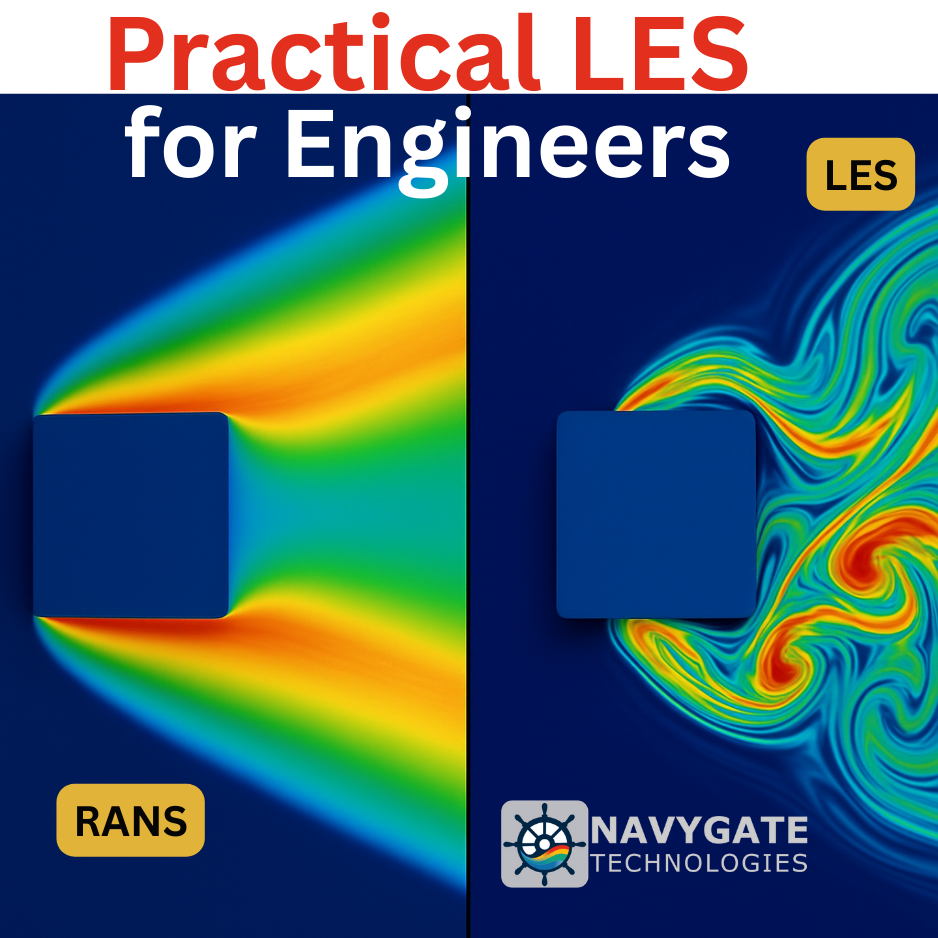
A key feature of this course is a complete workflow of applying LES models to a real engineering test case: turbulent flow past a square cylinder. All SGS models discussed—Smagorinsky, WALE, k-equation models, and hybrid RANS–LES approaches—will be implemented and tested on this geometry. You will analyze vortex shedding, wake dynamics, turbulence statistics, and mesh requirements for accurate LES.
Additionally, we will compare all LES predictions against a baseline RANS simulation using the k-ω SST model, enabling you to understand strengths, limitations, and cost–accuracy trade-offs between RANS, LES, and hybrid LES approaches.
What You Will Learn
- Derivation of LES equations from the Navier–Stokes equations.
- Spatial filtering, filter properties, and filter width definitions.
- Subgrid-scale (SGS) stress derivation and physical interpretation.
- Implementation and comparison of key SGS models: Smagorinsky, WALE, k-equation, dynamic models, and hybrid RANS–LES (DES/IDDES).
- Practical LES setup for flow past a square cylinder, including mesh design, resolution checks, and turbulence statistics.
- Comparison of LES results with a baseline k-ω SST RANS simulation to assess accuracy and model behavior.
- Estimation of Kolmogorov scales, eddy length scales, and turbulent spectra.
- Guidelines for wall-resolved vs. wall-modeled LES and practical resolution recommendations.
- Understanding Favre filtering and basics of dynamic SGS modeling.
Intended Learners
- Graduate students in fluid mechanics, CFD, and related fields.
- CFD engineers transitioning from RANS to LES/hybrid modeling.
- Researchers studying turbulence, wake flows, or unsteady bluff-body aerodynamics.
- OpenFOAM users wanting hands-on LES experience.
- Professionals needing practical LES skills for engineering applications.
Prerequisites
- Basic knowledge of fluid mechanics and turbulence fundamentals.
- Familiarity with numerical methods (finite volume recommended).
- Prior exposure to CFD tools (e.g., OpenFOAM, Fluent, Star-CCM+).
- Comfort with calculus, differential equations, and vector/tensor notation.
- (Optional) Basic programming skills for post-processing and automation.
Reviews
There are no reviews yet.