
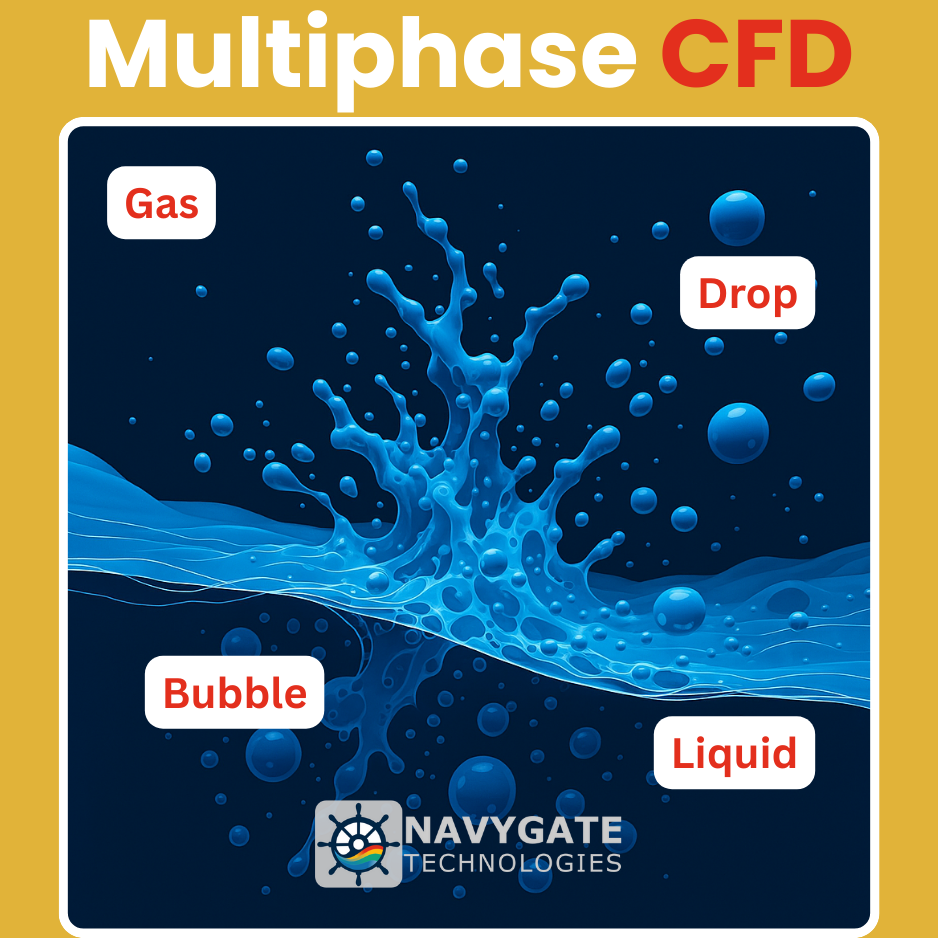
Description
This course provides a structured, step-by-step learning pathway for understanding and using OpenFOAM’s multiphase, phase-change, and compressible solvers. Beginning with basic incompressible VOF solvers like interFoam, learners progress through advanced topics such as geometric interface capturing (IsoAdvector), phase-change modelling, compressible multiphase flows, and Eulerian multiphase approaches.
The course explains governing equations, physical modelling assumptions, solver capabilities, and recommended learning sequences. It also dives into algorithmic details such as PLIC reconstruction, geometric flux computation, and mixing vs immiscible transport modelling in OpenFOAM solvers like twoLiquidMixingFoam and interMixingFoam.
The course is designed for learners who want a clear conceptual and practical understanding of how OpenFOAM handles multiphase flows — from basic VOF advection to advanced N-phase and reacting multiphase systems.
What You Will Learn
By completing this course, you will be able to:
Multiphase Solver Fundamentals
- Understand the governing equations of incompressible multiphase flows.
- Use VOF-based solvers: interFoam, interIsoFoam, twoLiquidMixingFoam, and interMixingFoam.
- Distinguish miscible vs immiscible models and when to use each solver.
Interface Capturing Techniques
- Learn how standard VOF advection works and its limitations.
- Understand the IsoAdvector geometric VOF method.
- Implement concepts like Piecewise Linear Interface Construction (PLIC).
- Understand geometric flux calculation and mass conservation advantages.
Phase-Change & Compressible Multiphase Solvers
- Use solvers like interPhaseChangeFoam, interCondensatingEvaporatingFoam, and cavitatingFoam.
- Understand the coupling between mass transfer, phase change, energy equations, and compressibility.
Advanced Multiphase Modeling
- Learn the structure and assumptions of Euler–Euler models:
twoPhaseEulerFoam, multiphaseEulerFoam, reactingMultiphaseEulerFoam. - Understand slip velocity, interphase momentum transfer, and heat/mass transfer.
Mathematical & Numerical Foundations
- Apply mixture properties and constitutive relations (density, viscosity models).
- Understand diffusion-driven mixing and species transport for miscible flows.
- Analyze interface curvature, surface tension modelling, and numerical stability.
Best Practices
- Follow a step-by-step OpenFOAM learning path from basic to advanced systems.
- Build intuition using canonical problems: dam break, bubble rise, droplet impact, etc.
- Learn solver selection criteria based on physics, assumptions, and modelling needs.
Intended Learners
This course is ideal for:
- Engineering students (UG/PG) wanting to learn multiphase CFD using OpenFOAM.
- Researchers working in fluid mechanics, multiphase flows, phase change, or interfacial phenomena.
- Professionals in CFD, chemical engineering, marine engineering, energy systems, and process engineering.
- Beginners in OpenFOAM who want a guided, structured path to multiphase solvers.
- Anyone studying VOF methods, interface capturing, or numerical modelling.
No prior multiphase experience is required.
Prerequisites
To follow this course comfortably, you should have:
Required
- Basic understanding of fluid mechanics (continuity, momentum equation).
- Ability to use Linux command line.
- Basic familiarity with OpenFOAM case structure (0/, constant/, system/).
- Understanding of mesh generation basics.
Recommended (but not mandatory)
- Prior experience running simple OpenFOAM solvers (e.g., icoFoam, simpleFoam).
- Basic knowledge of partial differential equations and numerical methods (FVM concepts).
- Fundamental calculus and vector analysis.
RAFAEL GUSTAVO (verified owner) –
Very helpful course. The topics are explained in a simple and practical way, and the demonstrations make it easier to follow along and apply the concepts.