
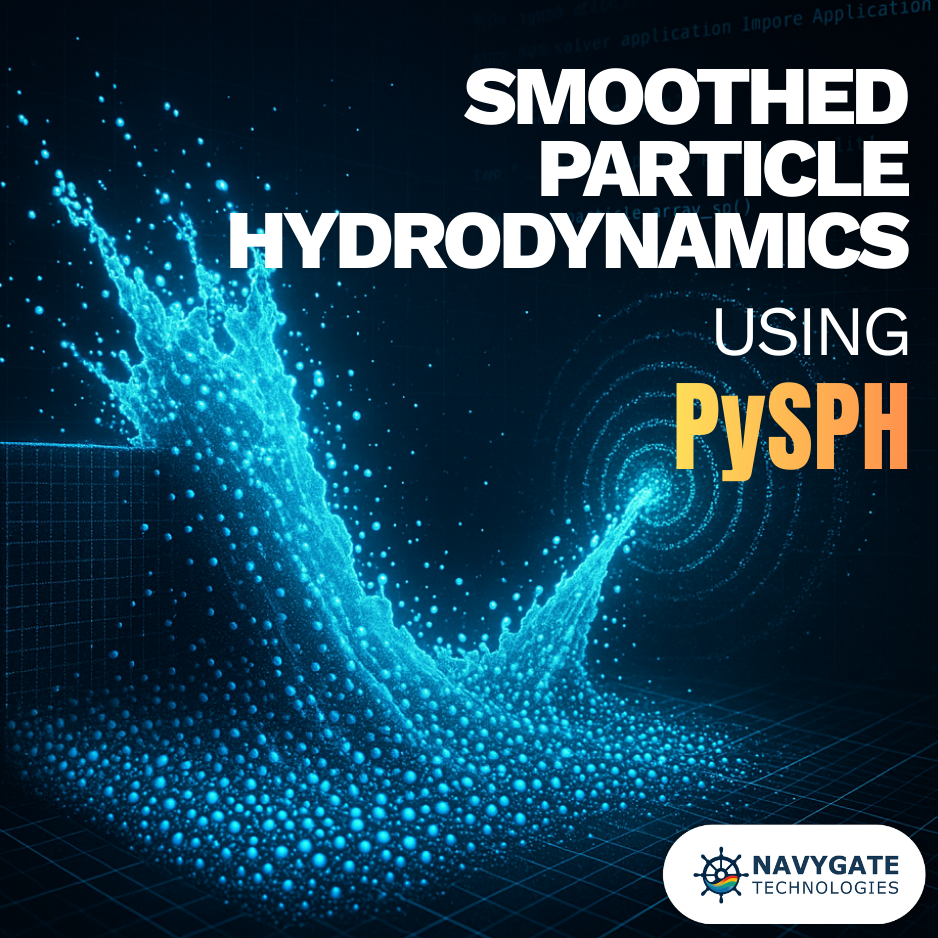
Description
This comprehensive course is designed to take you from the foundations of Smoothed Particle Hydrodynamics (SPH) to building and running full SPH simulations using PySPH, an open-source, Python-based SPH framework developed at IIT Bombay.
Whether you are a beginner in meshless methods or an experienced CFD engineer, this course provides a complete, hands-on journey through theory, implementation, and practical simulation workflows.
Across multiple lectures, you will learn how SPH works mathematically, how to install and use PySPH efficiently, and how to implement classic test cases like the Shock Tube and Dam Break simulations. You will write real SPH codes in Python, explore kernel interpolation, construct custom integrators, and run simulations using both local installation and Docker.
What you will Learn
- Understand the fundamentals of Smooth Particle Hydrodynamics (SPH)
- Implement interpolation methods (Polynomial, Lagrange, Fourier)
- Compute SPH gradients, derivatives, and density formulations
- Create particle arrays and physical fields in PySPH
- Implement SPH equations (Momentum, Energy, Density Summation)
- Use Gaussian kernels and understand kernel properties
- Write custom integrators (Euler step) in PySPH
- Group equations and configure solver structures
- Build and run Shock Tube and Dam Break simulations
- Install PySPH, Compyle, and Cyarray using Conda
- Run PySPH using Docker for a no-install workflow
- Export and visualize simulation output in ParaView & Mayavi
Intended Learners
- Students and researchers in CFD, FEA, or computational mechanics
- Engineers working with fluid dynamics or particle-based simulations
- Python users interested in numerical methods and simulation workflows
- Beginners who want a hands-on introduction to SPH
- Professionals exploring open-source alternatives to commercial CFD tools
Prerequisites
- Basic Python programming (variables, functions, modules)
- Introductory knowledge of fluid mechanics or numerical methods
- Familiarity with Linux or terminal commands (useful but not mandatory)
- No prior experience with SPH or PySPH required
Reviews
There are no reviews yet.